Definition#
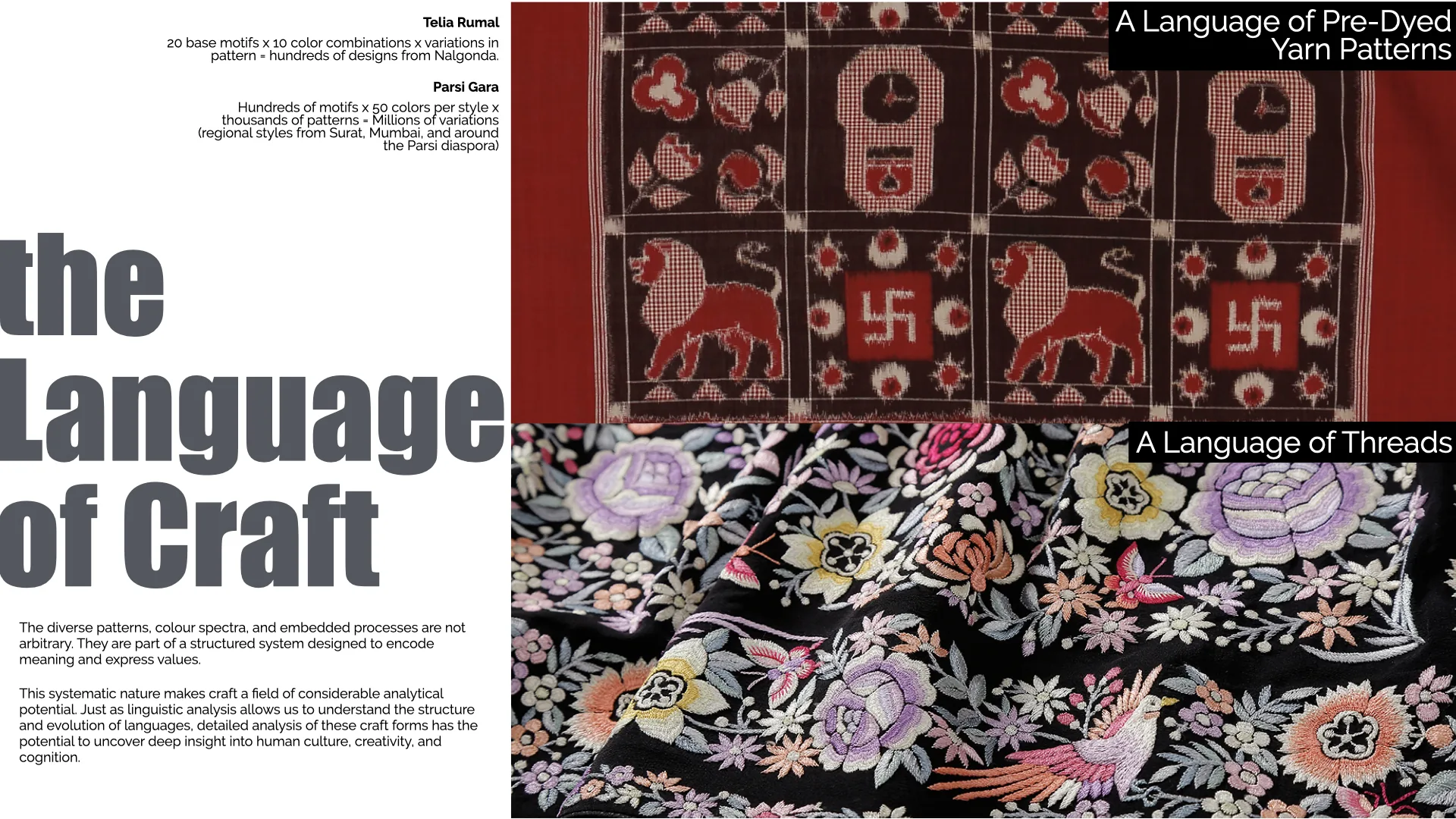
The Language of Craft is Direct Create’s reading of a craft tradition as a working language, with a vocabulary of motifs, materials, and colors, a grammar of combinatorial rules, and an expressive range a fluent practitioner commands. A finite base produces a near-infinite set of legible designs, which is the structural property of every natural language. Read this way, the artisan is the fluent speaker and the brief is a sentence the language can be asked to form.
Elaboration#
The frame sits on Roland Barthes’s semiotic account of culture as a sign system, where the signifier, the material form, and the signified, the cultural meaning, are separable and their relationship is the object of analysis. Direct Create adds the operational specification. The vocabulary is the set of motifs, materials, and color families a tradition holds. The grammar is the rules of combination that decide which pairings read and which break the form. The expression is the legible design the two produce together. The Jaipur “What is Culture Code?” workshop grounds the claim in two living traditions, Telia Rumal from Nalgonda, where twenty base motifs and ten color combinations yield hundreds of legible designs, and Parsi Gara from the Parsi diaspora of Surat and Mumbai, where hundreds of motifs across fifty colors per style yield millions of legible variations.
The reading is practitioner-led. The artisan holds the language, the studio brings the brief. This keeps the cultural authorship with the community that built the tradition, and it makes the next design a sentence in an old language rather than a new object imposed on it.
Applications#
The Language of Craft is the analytic core of the Culture Code framework and feeds every Culture Stack reading. It opens Culture Code presentations, anchors the essays on craft as language, and frames advisory decks where the cultural argument turns on a tradition’s combinatorial depth.
Tensions and boundaries#
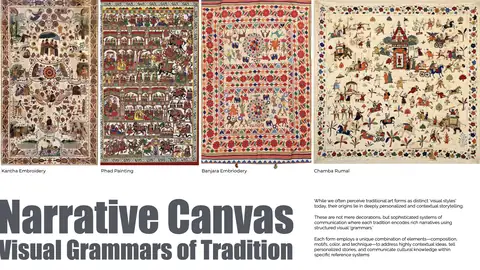
The frame holds for traditions that carry a genuine combinatorial mathematics, which most Indian craft traditions do, though not all in the same way. Where a tradition carries a full story grammar rather than a combinatorial one, the reading shifts to the narrative canvas. The language frame must never flatten an artisan into a vocabulary list, since the grammar lives in the maker rather than in a chart.