Description#
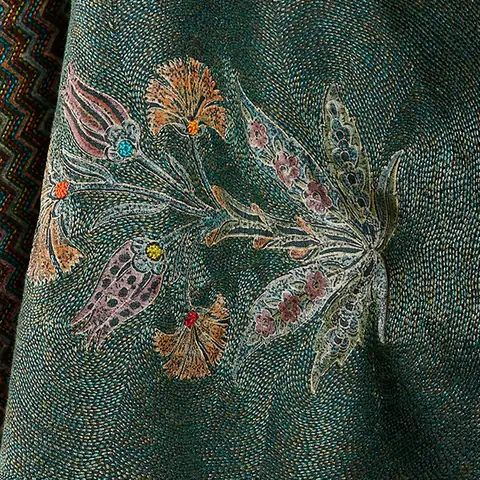
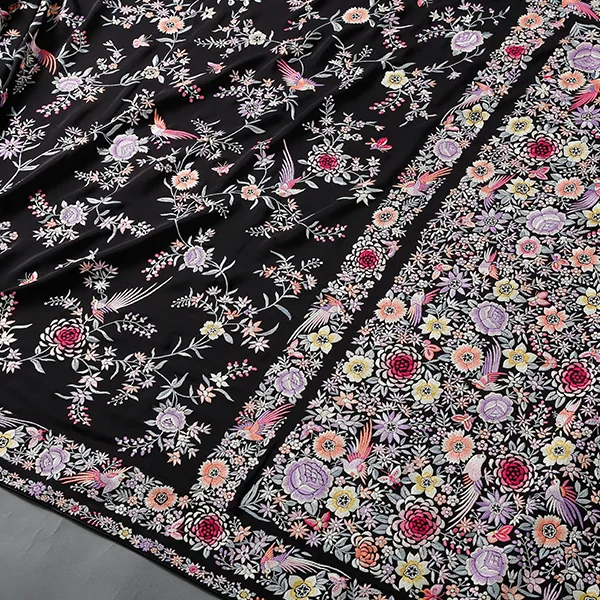
Parsi Gara is a hand-embroidered textile tradition carried by the Parsi community, worked most often on the border and pallu of a sari or on panels for other garments. The embroidery draws on a vocabulary of motifs, birds, flowers, vines, pagodas, and figures among them, worked in silk thread in a range of stitches. The tradition’s combinatorial range is wide. The Jaipur “What is Culture Code?” workshop deck describes it as hundreds of motifs across roughly fifty colors per regional style, compounding into thousands of patterns and, across the full spread of regional styles from Surat, Mumbai, and the wider Parsi diaspora, into millions of variations.
Cultural context#
The tradition traces its lineage to the trade contact between Parsi merchant families and China, from which the embroidery took its Chinese silk-embroidery influence and its characteristic motifs. Surat and Mumbai, as the historic centers of Parsi settlement and trade in western India, are named as the tradition’s principal geographies, with regional style variation across both cities and the wider Parsi diaspora. The craft is carried inside a specific community’s material culture and worn on ceremonial and life-cycle occasions.
Direct Create's reading#
Direct Create’s Jaipur “What is Culture Code?” workshop (slide 008) pairs Parsi Gara with Telia Rumal as the two evidences for the Language of Craft argument, that a craft tradition functions as a language with a finite vocabulary of motifs and a grammar of combination that produces a near-infinite expressive range. The on-slide caption reads: “Parsi Gara, Hundreds of motifs x 50 colors per style x thousands of patterns = Millions of variations (regional styles from Surat, Mumbai, and around the Parsi diaspora).” Where Telia Rumal demonstrates the mathematics at the scale of a single regional tradition, Parsi Gara demonstrates the same mathematics compounding across regional style and diaspora variation. The reading sits inside the Culture Code framework under the vocabulary-grammar-expression triad.
Design applications#
Direct Create has not yet documented a project engagement with Parsi Gara; the craft’s presence in the wiki to date is as evidence in the Jaipur workshop deck rather than as a commissioned or advisory application. Any future design application should be built from a fresh research pass rather than from this page alone.