Framework

The Narrative Canvas

By Rajeev Lunkad

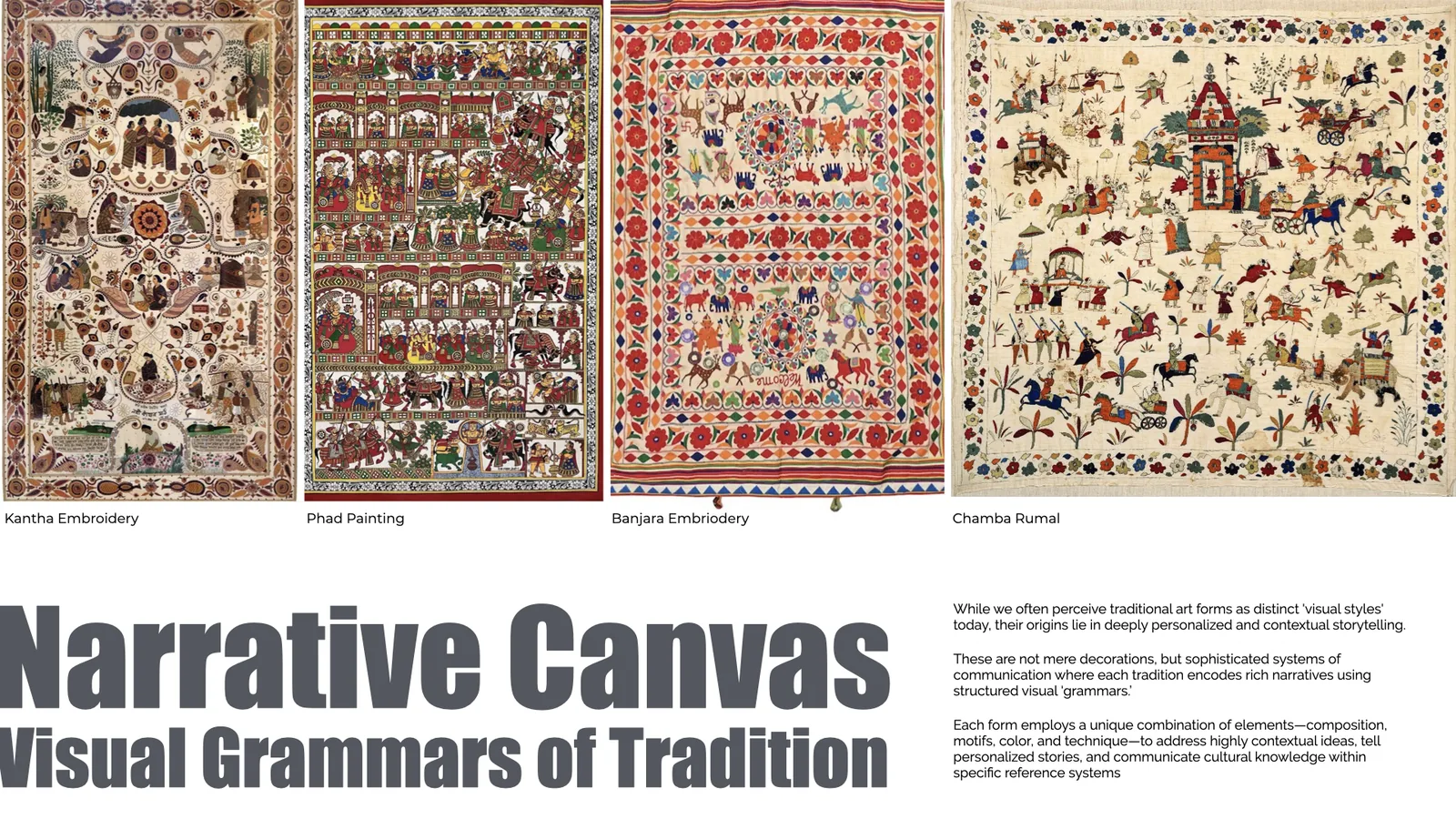
The Narrative Canvas grammars across Kantha, Phad, Banjara, and Chamba Rumal.

Definition#

The Narrative Canvas is Direct Create’s name for the strongest end of the craft-as-language spectrum, where a tradition carries a full narrative grammar and the cloth or the scroll is itself a story-bearing surface. These traditions hold conventions for sequence, character, scale, and ritual closure, so the craft does not merely decorate, it narrates.

Elaboration#

Where the language of craft reading shows that a tradition has vocabulary and grammar, the narrative canvas shows that some traditions carry the grammar all the way to literature. The Jaipur workshop grounds the claim in four traditions. Kantha embroidery from Bengal is the running-stitch narrative worked on layered worn cotton. Phad painting from Rajasthan is the Joshi-family scroll the Bhopa singers narrate. Banjara embroidery is the dense pieced and mirrored work of the transhumant Banjara, Lambadi, and Lambani communities. Chamba Rumal from Himachal Pradesh is the double-sided silk drawn from the Pahari miniature school. The four are geographically and materially distinct, which is the point. The narrative-carrying features are operative across all of them, so narrative depth is a real structural property of the tradition rather than a romantic claim about meaning.

Applications#

The narrative canvas is the distinguishing move of the Culture Code framework, the claim that separates it from generic statements that craft is meaningful. It anchors the essays on craft as literature and the advisory decks where the cultural intelligence claim turns on narrative depth.

Tensions and boundaries#

The bar is high. A tradition enters the narrative canvas only when it carries an actual story grammar rather than merely figurative motifs. Pattachitra and Madhubani would qualify, many decorative traditions would not, and naming them as narrative would weaken the claim. The reading holds the line between figuration and narration.
Evidence

Method
Direct Create's reading of the strongest end of the craft-as-language spectrum, demonstrated through four traditions at the What is Culture Code? workshop in Jaipur on 30 January 2025 and carried on workshop slide 009. Corrections: write to rajeev@directcreate.com naming the page and the line.
Observations
  • The four traditions on slide 009, each with its own caption: Kantha from Bengal, running-stitch narrative on layered worn cotton; Phad from Rajasthan, the Joshi-family scroll the Bhopa singers narrate; Banjara embroidery of the transhumant Banjara, Lambadi and Lambani communities; Chamba Rumal from Himachal Pradesh, double-sided silk drawn from the Pahari miniature school.
  • The four are geographically and materially distinct, which is the load-bearing observation. The narrative-carrying features run across all four.
Sources
  • What is Culture Code? Future of Tradition workshop presentation, Jaipur, 2025-01-30
  • Narrative Canvas grammars, Kantha, Phad, Banjara and Chamba Rumal, workshop slide 009, 2025-01-30
Attribution
Author: Rajeev Lunkad, Direct Create. The four traditions belong to the communities that hold them and are cited here as evidence.
Uncertainty
Which traditions carry a story grammar is Direct Create's own judgment. The four named here are described from the workshop record and the practice's own encounters with them rather than from an ethnographic survey. Pattachitra and Madhubani are named on the page as traditions that would qualify; neither has been worked through the frame. The line between figuration and narration is a reading, and it is the reading the page asks to be held to.
Reviewed
2026-09-10

Continue

Four lenses are an argument until an engagement carries them into made objects. The Dadar Edit → You will learn How a Mumbai neighborhood was read into three carpets across three craft traditions.
Continue, inside Frameworks

The lenses were used on a real commission. Read the Dadar Edit.