Case study

Dadar Edit

Three handmade floorcoverings for Broadway Malyan's Mumbai studio. Kharad from Bhuj, Panja from Dausa, Bhadohi tufting from Uttar Pradesh, threaded into one reading of Mumbai.

Place Mumbai, MaharashtraFor Broadway MalyanWhen 2024-05 to 2024-08Crafts Panja DhurrieDirect Create's role project director, design consultant, author By Rajeev Lunkad, published 2024-08-21

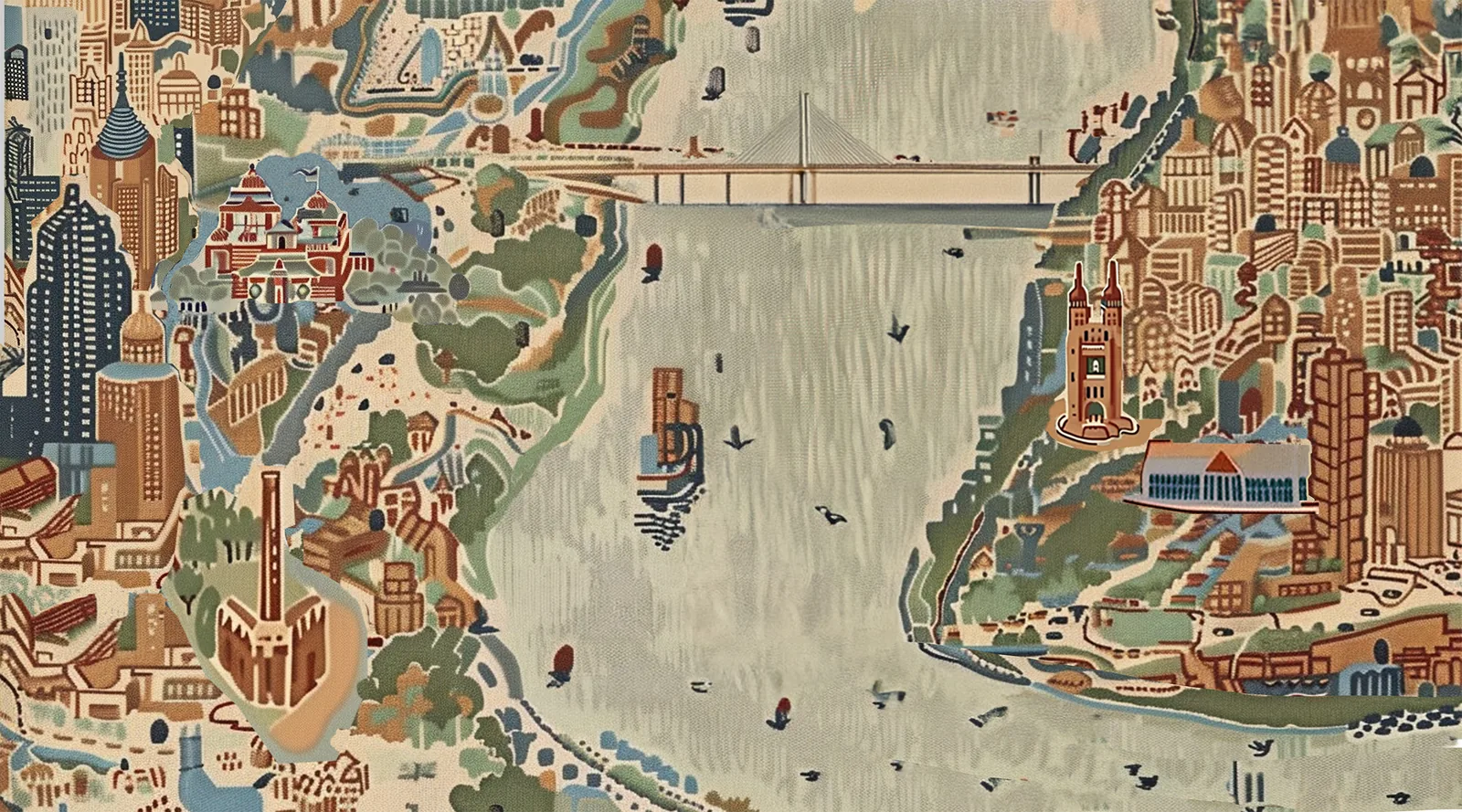
Dadar Scape, the Bhadohi hand-tufted carpet's final artwork: Mahim Bay from above with the Mithi River and the Sea Link.
Dadar Scape, the Bhadohi hand-tufted carpet, final artwork: Mahim Bay from above, with the Mithi River and the Bandra-Worli Sea Link.Artwork: Direct Create for Broadway Malyan, June 2024. Chosen by Rajeev Lunkad, 2026-09-06.

In six parts

How a Mumbai neighbourhood became three carpets, in the order the work happened.

  1. 1

    Place

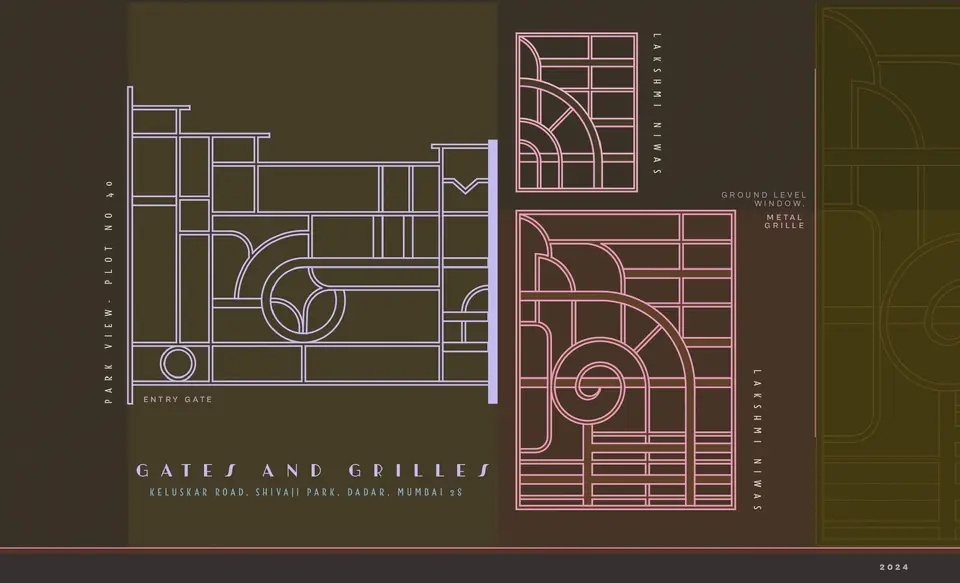
    Dadar, read from its streets: the Art Deco gates and grilles of Shivaji Park and Parsi Colony, the mills, the bay.

    Drawing of Art Deco gates and grilles on Keluskar Road, Shivaji Park, Dadar: three line-drawn railings, an entry gate and a window grille.
    Gates and grilles of Keluskar Road, Shivaji Park, drawn from the street. Dadar's Art Deco is a working vocabulary before it is a style. Open at full sizeDrawing: Direct Create, Dadar Edit research, 2024. From the project's own archive. Direct Create's own drawing.
  2. 2

    Reading

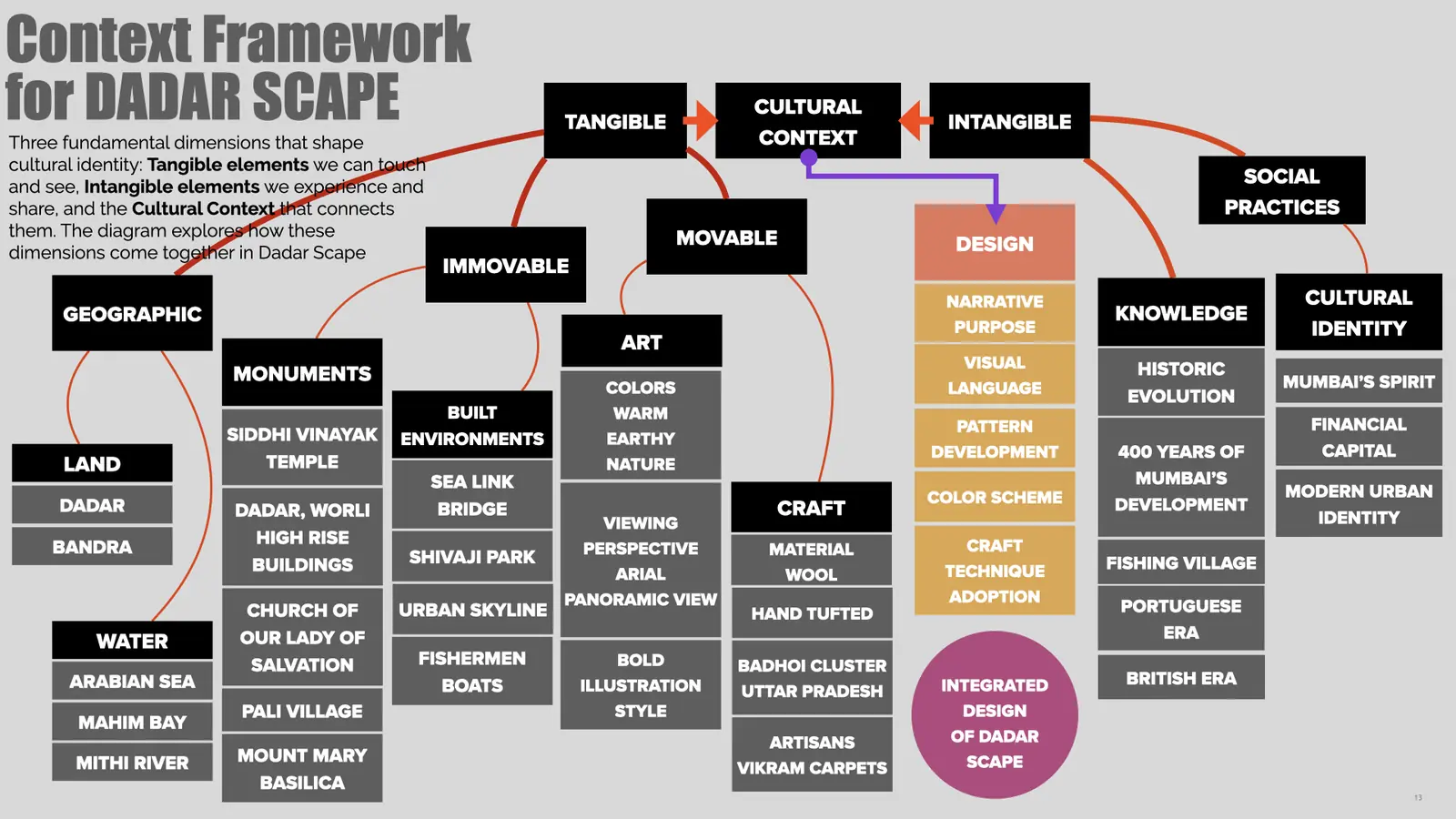
    The place is organised before anything is drawn: tangible, intangible, and the context between them.

    Context framework diagram for Dadar Scape mapping tangible, intangible and cultural-context dimensions of Dadar and Mumbai.
    The Context Framework for Dadar Scape. A Culture Stack organises what the fieldwork found before any composition begins. Open at full sizeDirect Create, Narrative Threads: Dadar Edit docket for Broadway Malyan, 2024 to 2025. Photograph and artwork from the project's own archive. Direct Create's own material; workshops named with recorded consent.
  3. 3

    Pattern

    The reading becomes a drawing, composed in the craft's own grammar so a loom can carry it.

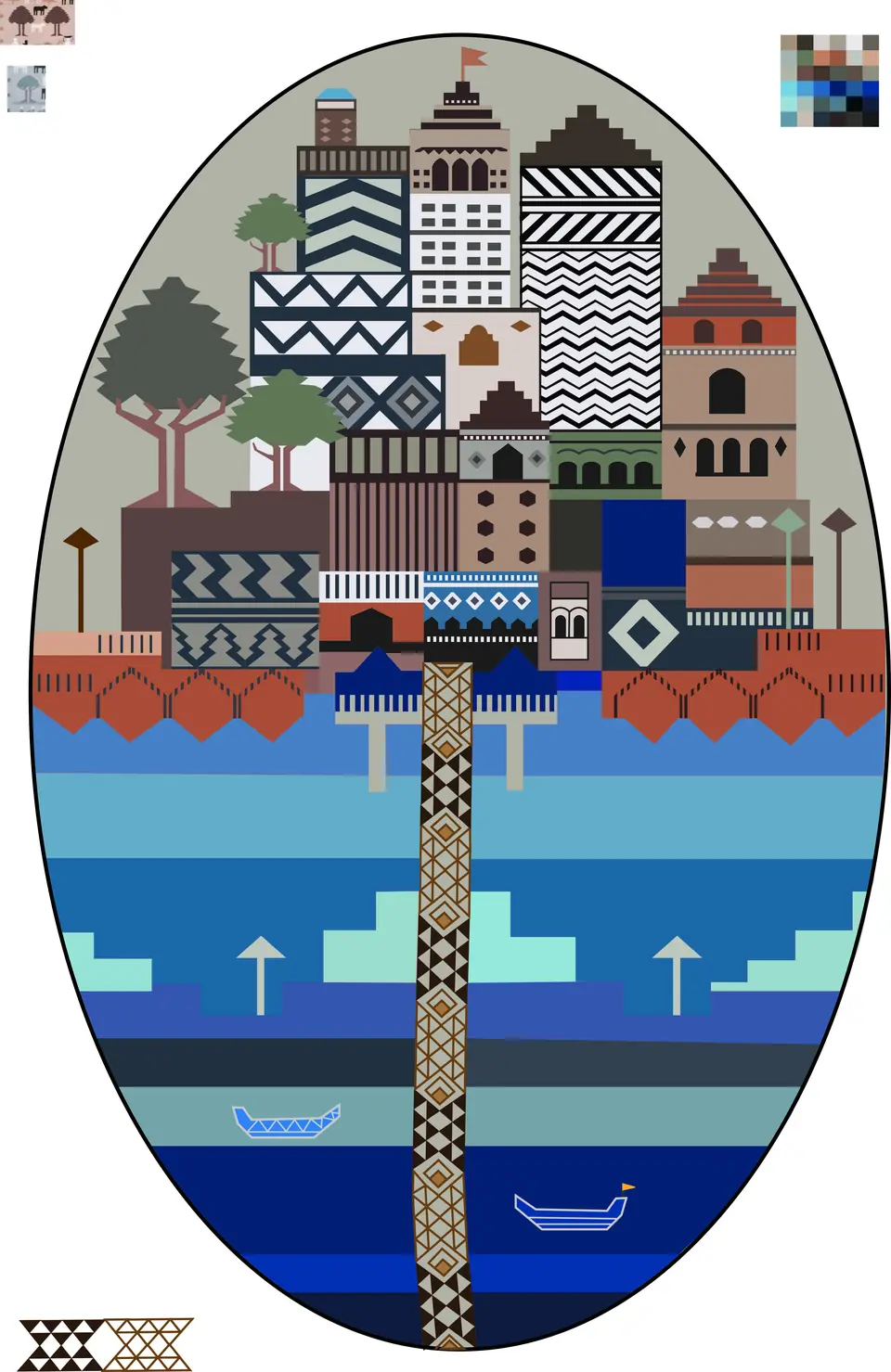
    Final artwork for Maxim Bay Mosaic: an oval composition of Dadar's skyline above the bay, with the yarn colour swatches beside it.
    The Maxim Bay Mosaic artwork with its yarn swatches. The drawing is made in the loom's grammar, so the weaver reads it without translation. Open at full sizeArtwork: Direct Create for Broadway Malyan, June 2024. From the project's own archive. Direct Create's own artwork.
  4. 4

    Craft grammar

    Each craft is a working language: a vocabulary of motifs, a grammar of combination, an expressive range.

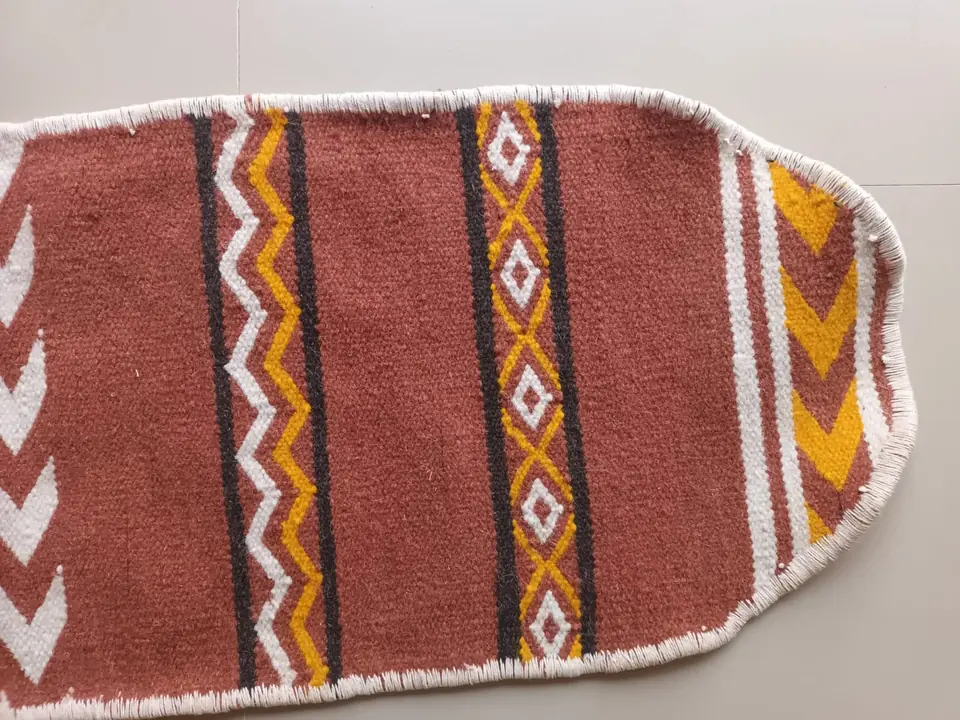
    A small Kharad sampler strip in rust, ochre, white and black: bands of chevrons, diamonds and zigzags woven as a test.
    A Kharad sampler from the Tejsi workshop. Chevron, diamond and zigzag are the loom's vocabulary; the sampler tests what it can say before the composition asks. Open at full sizePhotograph from the Dadar Edit project archive, the Tejsi family workshop in Bhuj, July 2024, shared on the project's WhatsApp thread. Direct Create's own material; the workshop is named with recorded consent.
  5. 5

    Weave

    The design leaves the studio and returns from the loom, frame by frame, across five locations.

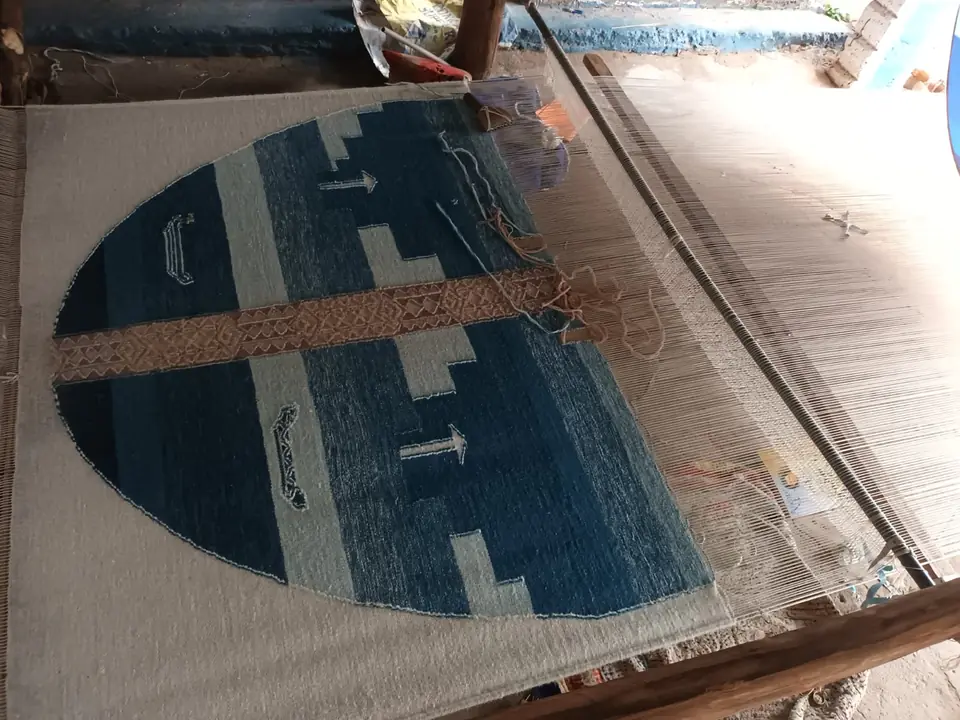
    The Maxim Bay Mosaic oval half woven on a Kharad ground loom in Bhuj, the blue bay and the central pier complete, the warp threads still stretched above.
    Maxim Bay Mosaic on the loom in Bhuj, July 2024. A frame of work left the loom in the morning and came back with design feedback by evening. Open at full sizePhotograph from the Dadar Edit project archive, the Tejsi family workshop in Bhuj, July 2024, shared on the project's WhatsApp thread. Direct Create's own material; the workshop is named with recorded consent.
  6. 6

    Finished object

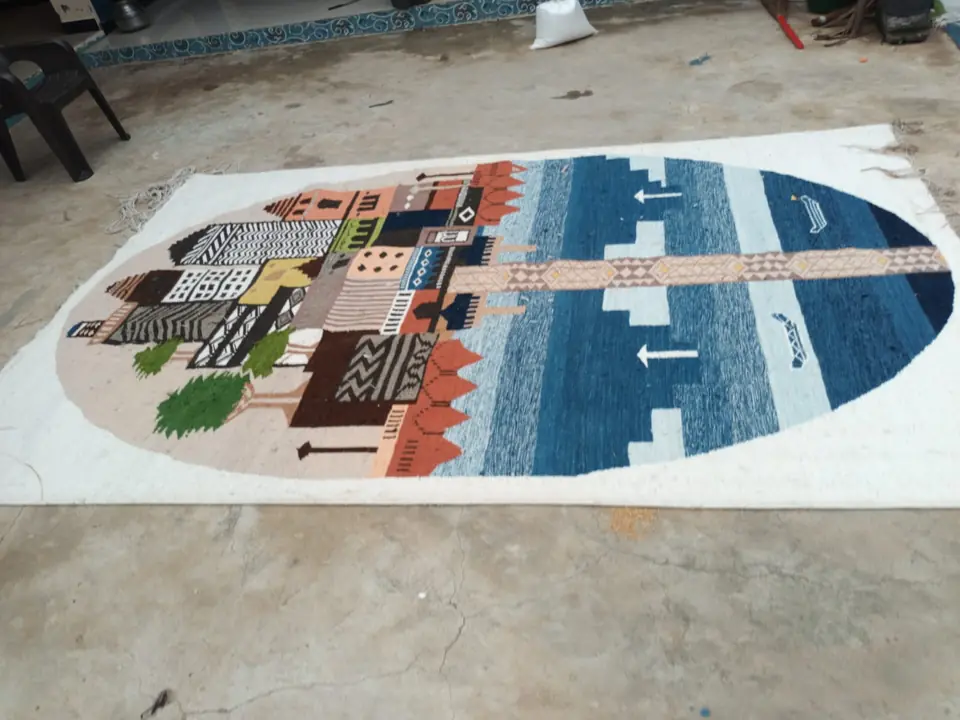
    Maxim Bay Mosaic: the Dadar skyline seen from the Sea Link, woven in Kharad on an oval.

    The finished Maxim Bay Mosaic laid flat on the workshop floor: the oval Kharad weave with Dadar's buildings above the striped blue bay and the pier.
    Maxim Bay Mosaic, finished, on the workshop floor in Bhuj. Woven by the Tejsi family workshop, one of three carpets from the same reading. Open at full sizePhotograph from the Dadar Edit project archive, the Tejsi family workshop in Bhuj, July 2024, shared on the project's WhatsApp thread. Direct Create's own material; the workshop is named with recorded consent.

Overview#

The Dadar Edit, subtitled Narrative Threads, is a collection of three handmade floorcoverings commissioned by Broadway Malyan for the firm’s Mumbai office at the Bandra Kurla Complex. Two are handwoven and the third is hand-tufted. The brief asked Direct Create to translate the cultural memory of Dadar into floor surfaces for a working architectural studio. The collection runs across three crafts and three geographies: Kharad weaving from Bhuj, Panja dhurrie from Dausa, and hand-tufted carpet from Bhadohi. Together the three pieces form a single narrative of Mumbai written in wool and cotton.

The project’s emotional thesis is Suketu Mehta’s “Maximum City,” Mumbai’s spirit of creative energy and dense possibility, named in the practice’s source documents as the spirit the collection reaches for. Each carpet translates a different reading of that spirit into the grammar of a specific craft. The play on “Maxim Bay” in the second piece’s name is a deliberate echo of the frame.

The reading#

The teaching of the Dadar Edit sits in the chain of transformation from place to narrative to pattern to weave. The first link is Dadar’s four-century arc from fishing village to Portuguese settlement, from British trade quarter to the modern republic’s financial capital. The second link is narrative selection. Direct Create chose three readings of Dadar rather than one, because the city resists a single voice. Dadar Scape, the 18-foot by 10-foot Bhadohi tufted carpet, carries a bird’s-eye view of Mahim Bay with the Mithi River and the Bandra-Worli Sea Link. Maxim Bay Mosaic, the 10-foot by 6-foot-6-inch Kharad oval, reads the same coastline from the bridge in mosaic form, with sky, water, and skyline stacked vertically. La Deco Mumbai, the 11-foot by 9-foot Panja dhurrie, abstracts the Art Deco legacy of early 20th-century Mumbai into geometric color. Each translation respects the grammar of its chosen craft: Kharad’s robust woolen flatweave for layered juxtaposition, Panja’s cotton precision for geometric clarity, Bhadohi’s tufted depth for cartographic detail. The narrative bends to the loom rather than the loom bending to the narrative.

Production and collaboration#

The collaboration ran across five locations and a single messaging thread. Saachi Mishra at Broadway Malyan held the client voice from Mumbai, Rajeev Lunkad held the design voice from Delhi, and three master artisans held the production hands in their respective workshops: Samarth Tejsi and the Tejsi family workshop at the Kharad loom in Bhuj, Shankar Lal Mali at the Panja loom in Dausa, and Raj Kumar at the tufting frame in Bhadohi. The Kharad piece was a family-led weave, with the Tejsi workshop carrying several pairs of related hands across the months of production; the rendering of any single weaver as a singular hero would misread what was in fact a workshop collaboration. WhatsApp carried the conversation across all five locations as a multimedia channel for sketches, color swatches, sample photographs, and production videos. The asynchronous, image-rich format proved well suited to artisan workflow, allowing a frame of work in progress to leave the loom in the morning and return with design feedback by evening. Direct Create held the producer role across all three commissions.

Lessons for the practice#

Three lessons travel out of the Dadar Edit into the rest of the Direct Create archive. First, Culture Stacking works at the scale of a single object as well as at the scale of a hotel, because the chain of place to material to craft to artisan can be compressed into one carpet without losing intellectual weight. Second, the advisory-implementation boundary holds even when Direct Create takes the producer role, because the practice produced the cultural narrative artifacts that sit within Broadway Malyan’s interior scheme rather than the office interior itself. Third, the Dadar Edit was one of the earliest Direct Create projects to use generative image tools as a design research instrument. Before any artisan was approached, mood, composition and color were explored in a set of research-stage sketches, three readings probed and set aside before the three-carpet structure locked: a Shivaji Park reading of cricket against high-rise apartments and the sea, a craft-grammar transfer test pairing Dadar’s urban landscape with Kharad compositional styles, and a form test for the oval that became Maxim Bay Mosaic. La Deco Mumbai used no generative imagery at all: its design was drawn directly from the Art Deco iron railings of Dadar’s Parsi Colony into Panja’s geometry, a pure design-and-craft translation. The sketch served the designer and never substituted for the maker, and that posture has carried into every subsequent project that uses generative tools at the research stage.

Published#

The cultural argument of the Dadar Edit became an essay on the Future of Tradition Substack, titled “The Dadar Edit: Weaving Mumbai’s Stories.” The essay extracts the cultural translation method from the project record and presents it as a stand-alone piece on craft, place, and narrative. It remains the canonical public articulation of the project.

A per-carpet publication series followed on the same hub, one essay, carousel, and reel for each carpet. Dadar Scape, the Bhadohi piece, published 13 June 2026 at https://rajeevlunkad.substack.com/p/dadar-scape. Maxim Bay Mosaic, the Kharad piece, published 16 June 2026 at https://rajeevlunkad.substack.com/p/maxim-bay-mosaic, reading the Mumbai bay from the Bandra-Worli Sea Link in Kharad’s geometry, with a making film scored to the track Woven in Amber. La Deco Mumbai, the Panja piece, published 17 June 2026 at https://rajeevlunkad.substack.com/p/la-deco-mumbai, completed the three-carpet series.

Evidence

Method
Culture Stacking compressed to the scale of one object: Dadar scoped as the place, its four-century arc read through three narratives, each translated into the grammar of a specific craft (Kharad, Panja, Bhadohi) and woven by its workshop; Direct Create held the producer role.
Observations
  • Kharad production documented at the Tejsi family workshop, Bhuj, 8 July 2024: yarn dyeing and drying, the Maxim Bay oval on the loom, several pairs of related hands across the months of weaving.
  • Bhadohi tufting documented on video at the Raj Kumar workshop, Uttar Pradesh, 16 July 2024.
  • Panja dhurrie woven at Shankar Lal Mali's loom, Dausa; the La Deco Mumbai geometry drawn from the Art Deco railings of Dadar's Parsi Colony.
Sources
Attribution
  • Samarth Tejsi and the Tejsi family workshop, Bhuj (Kharad); Shankar Lal Mali, Dausa (Panja dhurrie); Raj Kumar, Bhadohi (hand tufting). Named as the workshops of record in the project's own presentation; named with their consent, recorded 7 September 2026.
  • Broadway Malyan, Mumbai: the commissioning studio, named with the studio's clearance for public reference.
Images
All photographs from the project's own archive, Direct Create and the workshops, May to August 2024.
Uncertainty
Exact commercial figures are withheld by choice. They are not withheld by NDA. The generative-image research sketches made before the artisans were approached are described but not shown.
Reviewed
2026-09-07

The essays that came from it

All writing →
  • Dadar ScapeDadar Scape is the first per-carpet essay in the Dadar Edit series, carrying the Bhadohi hand-tufted piece from the collection. The 18-foot by 10-foot carpet reads Dadar from directly above, a bird's-eye map of Mahim Bay carrying the Mithi River and the Bandra-Worli Sea Link rendered in tufted wool. The essay argues that Bhadohi's tufting depth is the craft best …
  • La Deco MumbaiLa Deco Mumbai is the third per-carpet essay in the Dadar Edit series, carrying the Panja dhurrie piece, an 11-foot by 9-foot flatweave. The essay reads Dadar through its Art Deco legacy, abstracting the iron railing patterns of the neighborhood's Parsi Colony into Panja's cotton geometry, rendered in the exuberant color of the global Art Deco age. Unlike the other …
  • Maxim Bay MosaicMaxim Bay Mosaic is the second per-carpet essay in the Dadar Edit series, carrying the Kharad-woven piece, a 10-foot by 6-foot-6-inch oval. Where Dadar Scape reads the bay from directly above, Maxim Bay Mosaic reads the same coastline from the Bandra-Worli Sea Link, stacking sky, water, and skyline vertically in mosaic form. The essay argues that Kharad's flatweave carries layered …
  • The Dadar Edit: Weaving Mumbai's StoriesThe piece is the opening essay of the Dadar Edit series and the first public account of the three-carpet commission for Broadway Malyan's Mumbai studio. It extracts the cultural translation method from the project record, a chain that runs from place to narrative to pattern to weave. The essay argues that Dadar's four-century arc, from fishing village to Portuguese settlement …

A study for your place

Engagements begin with Scoping: the governing question, the audience, the constraints and the shape of the Study, agreed before any fieldwork. The Study is the start of the work; the Commentary continues as long as a designer reads from it.

Write to Rajeev
Continue

Each carpet carries its own reading. Read the three essays.