Summary#
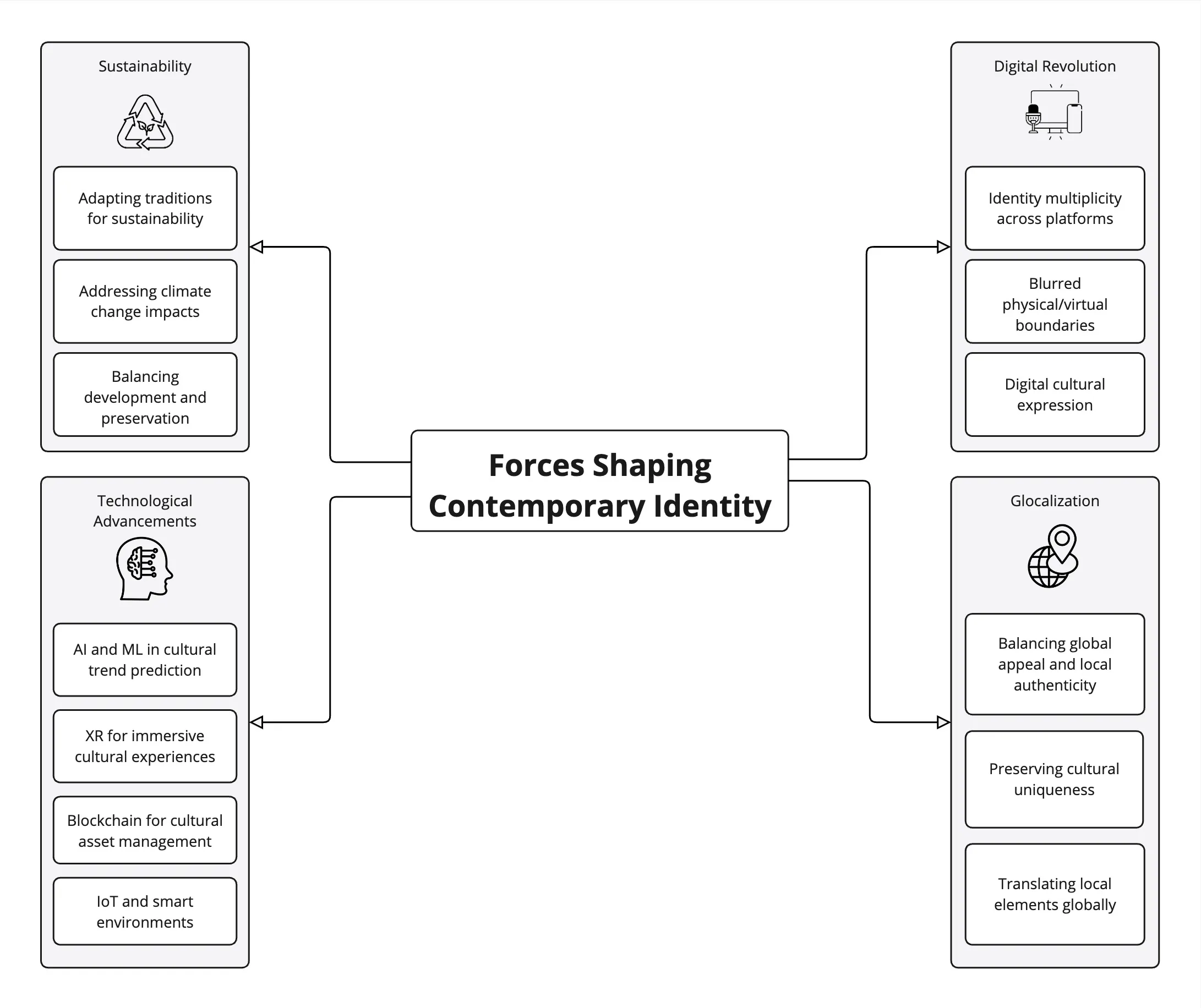
The piece is Direct Create’s published opening statement on cultural identity. It treats identity as a structure rather than a feeling, builds the structure out of tangible and intangible registers, and grounds the move in four scholarly anchors: Stuart Hall on dynamic identity construction, Roland Barthes on semiotics, Benedict Anderson on imagined communities, and Proshansky on place identity. The piece then names the four contemporary forces reshaping identity (digital revolution, glocalization, technological advancement, sustainability) and sketches a cultural referencing flow that moves traditional elements through selection, adaptation, and integration into modern expression. The essay sits at the foundation of every later Direct Create position on Culture Stack, Culture Code, and the broader Culture Codex.
Key claims#
The first claim is that identity has structure. Tangible elements and intangible practices form a single linguistic field, and reading identity well means reading both registers at once. The second claim is that identity is constructed. It is not given. Hall’s dynamic construction frame, Barthes’s semiotic frame, Anderson’s imagined community frame, and Proshansky’s place identity frame together describe a process that runs continuously across environments, symbols, narratives, and physical settings. The third claim is that identity is now under pressure. The four forces (digital revolution, glocalization, technological advancement, sustainability) act simultaneously on every tradition, every place, and every community, and a tradition that cannot move through the referencing flow risks losing its currency.