Definition#
The Culture Stack is the cultural intelligence of a place and a purpose, delivered as a Study a designer can build on. It investigates a place, holds what that place carries, and hands the designer a Study to interpret and create from. It is a substrate. It is not a solution. It informs the work; it never authors it.
A Culture Stack is hyper-local by design. Two projects on the same land produce different Studies, because purpose changes what matters. That specificity is the proof the instrument works, and it is the reason a Study cannot be transferred from one place or project to another.
The Culture Stack is the end product, the made thing. The process that produces it is Culture Stacking. The terms across the canon are fixed in the The Glossary, and every page, tool, and session uses those terms as defined.
What it is made of#
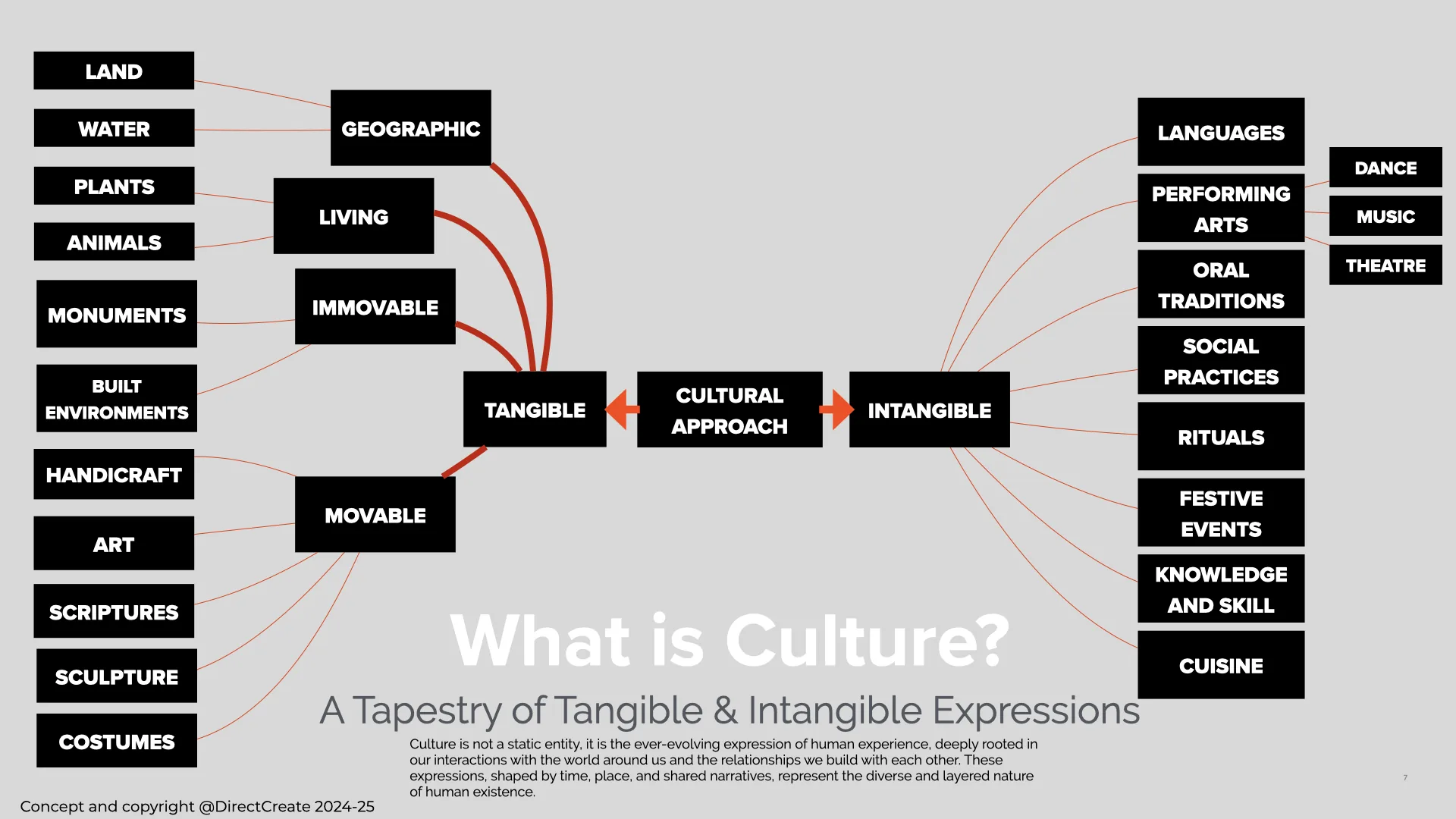
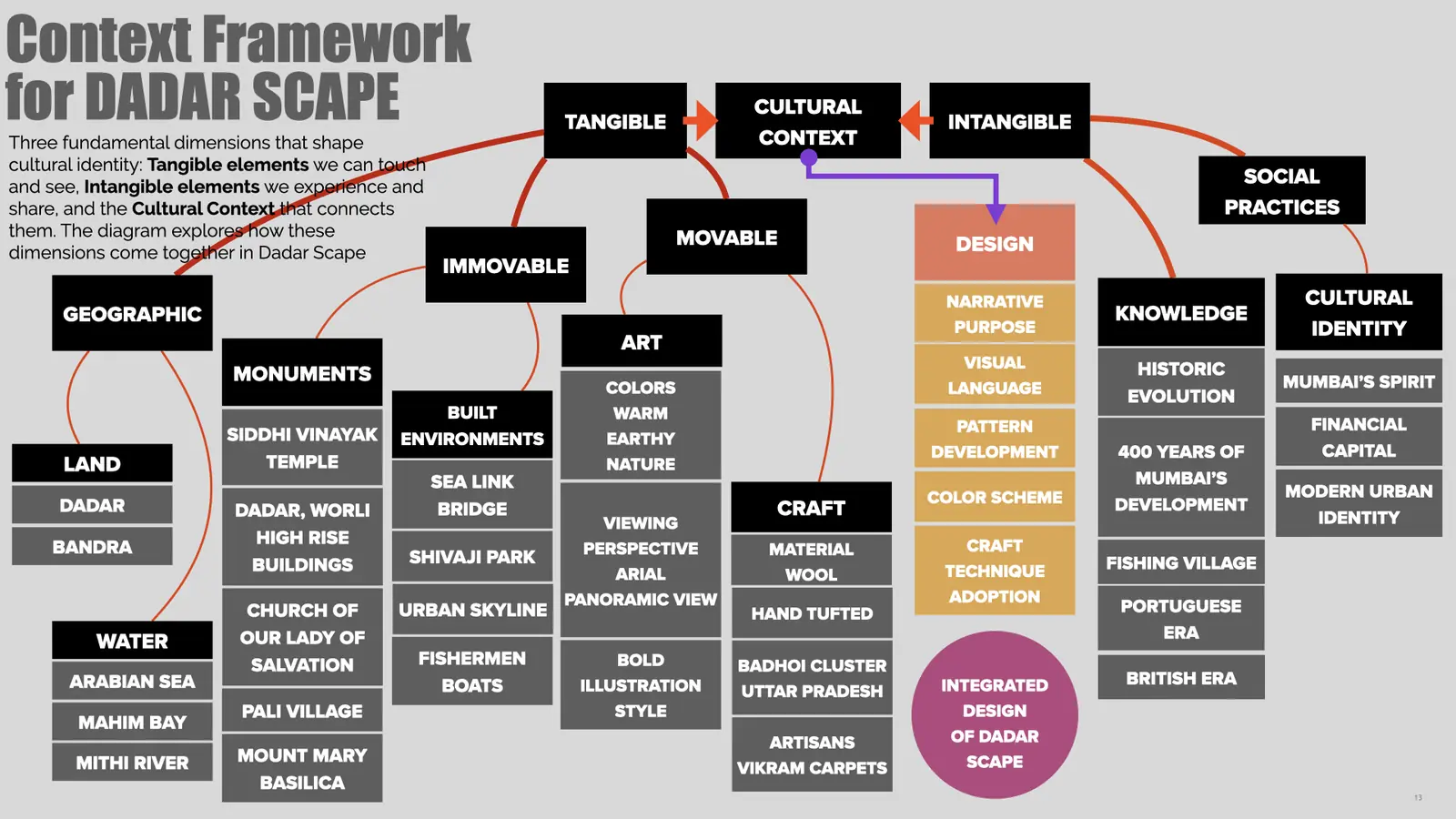
The material is the full set of cultural Fields, tangible and intangible. The tangible fields are the geographic, the living, the immovable, and the movable. The intangible fields are languages, performing arts, oral traditions, social practices, rituals, festive events, knowledge and skill, and cuisine. The Fields are universal and unordered, and they influence one another, so giving emphasis to one will often pull others with it.
Investigated in a specific place and grounded in its evidence, a Field becomes a Finding. Fields are the areas; Findings are what this place actually yields.
How it is built#
A Culture Stack is produced through a staged process, Culture Stacking, in five stages. Scoping sets the governing question. Fieldwork gathers the evidence across the Fields. Mapping cleans the evidence into Findings and traces how the Findings relate. Argument builds the Findings into a narrative and sets relative Emphasis for the project’s purpose. Edition composes the argument into the delivered Study of Chapters and Exhibits.
The same Findings under different Emphasis resolve into different and equally valid Studies. There is no single correct argument, only the one true for this context. Emphasis belongs to the Argument and is read from the finished Study; it is a structuring measure. It is never a formula, and it is never the build on its own. The full sequence and the working of each stage live on the Culture Stacking method page.
How it is delivered#
The Study is built to be presented, one narrative with an arc. Chapters are the sections, chosen for what the project needs, with the Findings visible inside each. Exhibits are the slides, each chapter a sequence of slide-ready exhibits.
Every exhibit carries six parts so it can stand on its own as a slide: a Title that states its claim, a Narrative written to be presented, an Evidence anchor of sourced facts, an Open meaning left for the reader, the Findings it expresses, and a Visual intention for the eventual image. Within every exhibit the rule holds. Complete evidence, open meaning. The facts are closed and sourced; the design implications are left open for the designer to draw.
An exhibit, in shape:
Title. Everything Here Begins at Talakaveri
Narrative. On the Brahmagiri ridge, at 1,341 meters, the Cauvery rises from a spring that slips underground and surfaces again below. The whole of Kodagu lies downstream of that one source. The water is the first cause. It is not a feature of the place.
Evidence anchor. Cauvery rises at Talakaveri, Brahmagiri range, 1,341 m; a revered source; nearly 280 inches of annual rain.
Open meaning. If the site sits downstream of a sacred source, what does the arrival sequence owe to water?
Findings. Geographic (lead), Rituals, Living.
Visual intention. The spring-fed tank at Talakaveri in monsoon mist, or a watershed section from ridge to estate.
How it is used#
A designer reads the Study as themselves. An architect, a landscape designer, a brand lead, and a product designer read the same Study differently, each through their own training and experience, and each reading can be right. The designer forms their own understanding, creates from it, and returns to the chapters to reconfirm as the work develops. The Study is a reference to return to. It is not a brief to run once and discard.
Delivering the Study is the start of the work. It is not the end. Direct Create’s continuing value is helping creatives interpret a Study: when they are unclear, when a new situation appears, or when two readings conflict. Every interpretation is captured as an Annotation, and the Annotations compound into a shared, retrievable Commentary.
What it is not#
A short guardrail set holds the instrument in place. These are the errors that keep creeping back into the work; a Study never supports them.
It is not linear. The Fields carry no fixed order and no chronology. Arranging them as strata, geology first and built form last, describes how a civilization emerged over time, which is a separate, descriptive exercise.
It is not deterministic. There is no formula, no sum to solve for, no single answer. The same Findings under different Emphasis give different valid Studies, and that openness is the method. It is not a defect.
It is not a solver. No tool turns a Study into a finished design, brand, or solution on its own. The Study informs a human author and never replaces one; auto-generating design moves from the Emphasis is forbidden.
It is not the Culture Code. The Study a designer builds on is not the framework that decodes how craft and artifacts carry meaning. Do not import craft or textile pattern grammars as if they were the Study’s output. Reading culture and building with it are different acts.
The full guardrail set adds further lines. A Study is not a machine or a grammar; it is not a catalog of right answers; it does not close the meaning; it is not one fixed lens; it does not rest on a single signal; and it is not served by forced analogy. This full set is held in the practice’s canon and binds every page, tool and session that builds on the Culture Stack.
The two governing laws#
Two laws govern everything built on the Culture Stack. Outputs are weighted by Emphasis and non-deterministic, so the Study offers readings and resolutions rather than a single verdict. The Study informs and is interpreted, so it supports the human author and never authors in their place. Every deliverable should name the Study it came from and remain a reference the reader can return to.