Definition#
Cultural Intelligence, as Direct Create defines it, is a discipline that pairs modern capability with civilizational depth, working to restore specificity to a world that industrialization has tended to homogenize. It reads culture at its source, refuses to flatten it into a category or a motif, and organizes it into knowledge that any domain can draw from. Where the industrial method advances by reduction, Cultural Intelligence advances by fidelity. It treats a culture the way a linguist treats a living language: a structure of vocabulary, grammar, and expression that keeps producing new and legible sentences. Direct Create is building toward recognition as the founding practice of this discipline.
The need it answers#
The modern world order runs on a single philosophical and economic lineage that presents itself as universal and is in fact parochial. That lineage advanced by reduction. To make the world manageable at scale, industrial systems compressed complex cultural structures, built over millennia, into categories, monocultures, and repeatable units. The simplification was a feature of mass production. It was not a flaw of it.
The cost of that reduction is now visible everywhere. Cities, brands, and experiences converge toward sameness. Character thins. People feel an identity vacancy they cannot always name. The demand-side has already named the absence in its own language: a louder ask, from millennials and Gen Z, for identity that is rooted, personal, and specific, expressed today through yoga, slow design, and the rejection of corporate sameness. Cultural Intelligence is the constructive answer to that felt absence. It is generative rather than preservationist, applied rather than critical, civilizational in scope rather than tactical.
The practice#
The discipline is practiced through three instruments, each built and tested across a decade of commercial work.
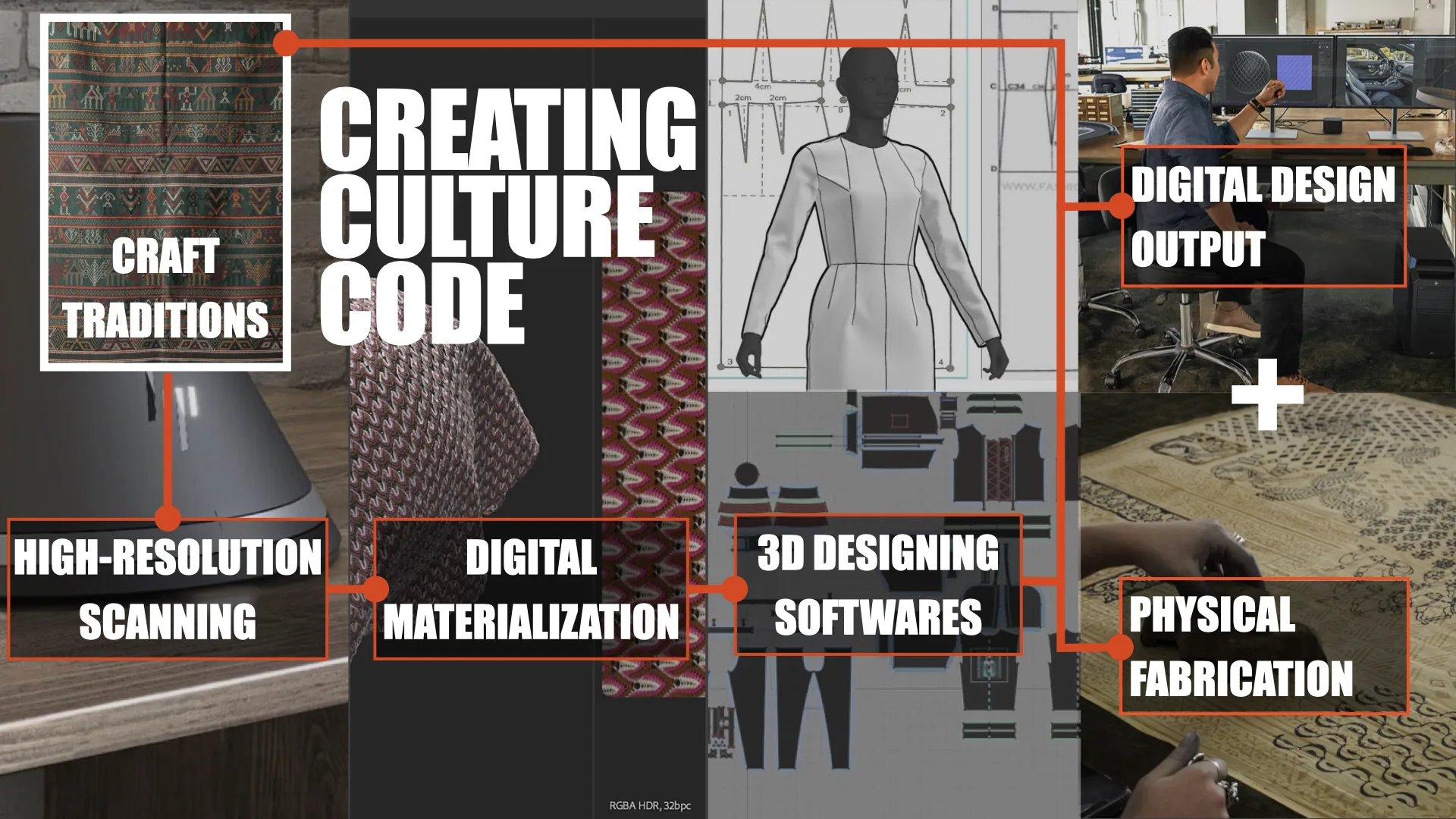
The Culture Stack is the end product: a place-and-purpose Study a designer builds on, produced through the five-stage Culture Stacking method (Scoping, Fieldwork, Mapping, Argument, Edition). The Culture Code is the framework that sits alongside it: it reads a craft tradition as a language of vocabulary, grammar, and expression, and it holds the artisan as the speaker of that language. The Culture Codex is the body of knowledge: the growing, structured reference through which the discipline is released to the world and, over time, extended by the practitioners who contribute to it. The terms used across all three instruments are fixed in the The Glossary.
Together these instruments let the discipline travel from a single object to a hotel, from a museum program to an AI training set, without losing fidelity to the culture at its source.
Lineage and distinction#
Cultural Intelligence has antecedents, and the discipline names them honestly. The phrase itself was used by Earley and Ang in 2003, in cross-cultural management scholarship, for an individual capability construct, the personal trait of functioning well across cultures, measured in the manner of IQ and EQ. Direct Create’s discipline is a different and wider thing. It is a field of applied practice rather than a trait of a person, and it works at organizational and civilizational scale rather than at the scale of the individual.
The governing precedent Direct Create reads from is yoga. Yoga did not travel because it was Indian; it traveled because it filled a felt absence in industrial life, and because codification, the Patanjali sutras, gave it the structure to move without losing its roots. It is now both a daily practice for hundreds of millions and an academic field, with many lineages and no single owner, the source recognized and respected. Two widely told precedents, on the same reading, suggest the same pattern: IDEO codified and taught Design Thinking until the approach traveled well beyond the firm, and Toyota’s production system generalized into Lean Manufacturing as a global field. In each, publishing the discipline appears to have conferred lasting authority as the source rather than eroding the founder’s standing.
Direct Create's relationship to the discipline#
Direct Create is the founding practice, and the claim is held in the building-toward tense. Direct Create is working toward recognition as the founding practice of Cultural Intelligence; it has not declared arrival, and the claim is credible in proportion to the visible propagation engine, the teaching and the Codex and the practitioners trained beyond the firm.
The discipline itself is open. It belongs to its practitioners rather than to Direct Create. What Direct Create owns is its own instruments and its own access layer: the Culture Stack and the Culture Stacking method that produces it, the Culture Code framework, and the Culture Codex as Direct Create curates it. Direct Create owns its work. It does not own the cultural space, and it does not own the living traditions of any community. The advisory practice is the operating arm. The discipline is the field, and the advisory practice is how Direct Create works inside it. The arc that took yoga two thousand years can compress, with the internet and the global design-education network, to the span of a decade.