Framework

The Tangible and Intangible Taxonomy

By Rajeev Lunkad

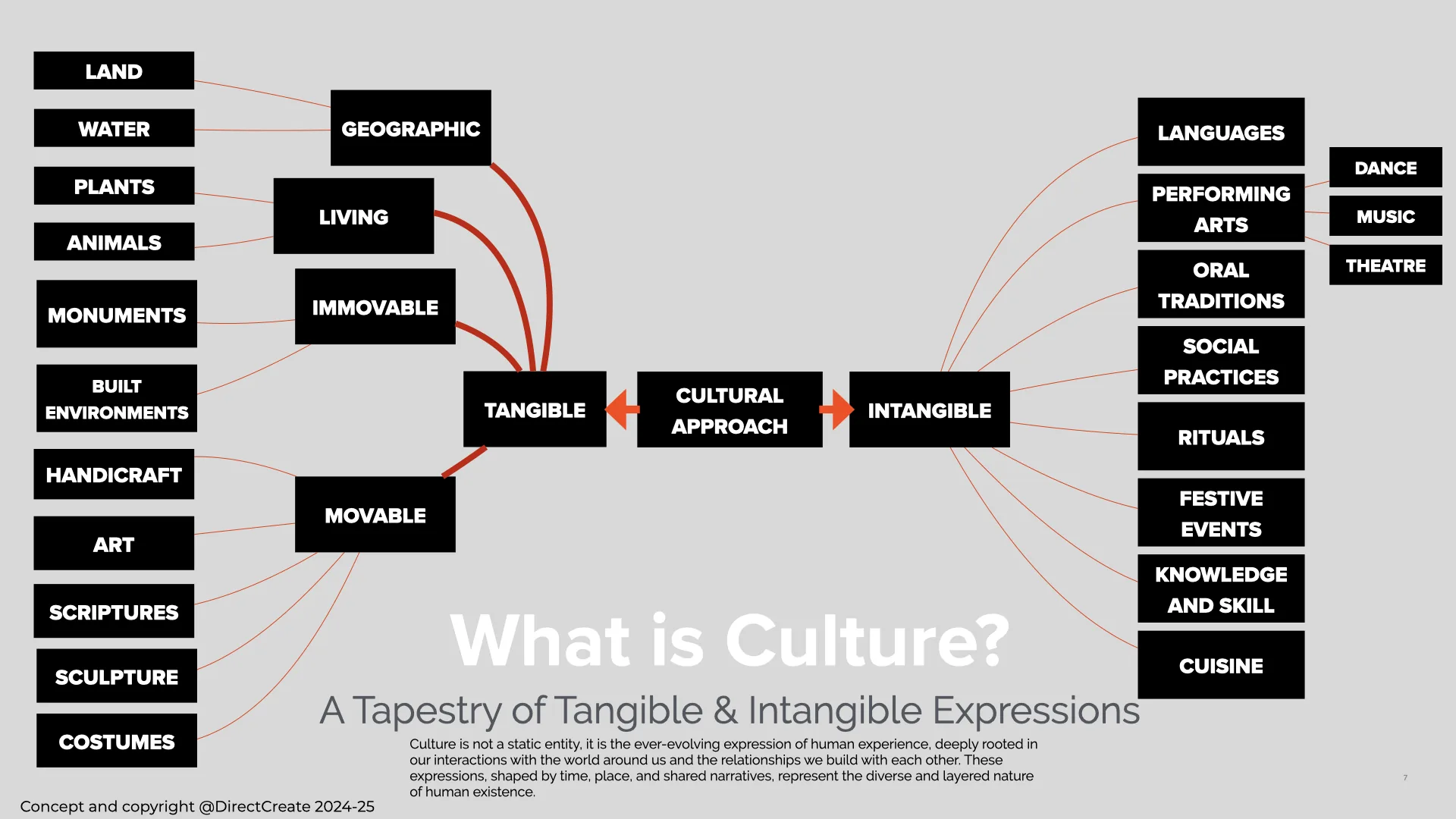
The tangible and intangible taxonomy of culture.

Definition#

The Tangible and Intangible Taxonomy is Direct Create’s split of a place’s culture into two coupled registers, the tangible of built form, material culture, and landscape, and the intangible of practices, rituals, stories, and the way a community names itself. Craft runs across both registers rather than sitting inside either alone: the craft object is read on the tangible branch, a made thing with weight and surface, while the craft knowledge behind it, the skill and technique a maker carries, is read on the intangible branch, because it lives in a person and a lineage rather than in the object. The two registers are read as one living system rather than as separate categories, because an identity is the relationship between them. It is not either one alone.

Elaboration#

The taxonomy rests on Stuart Hall’s account of cultural identity as a continuous construction, formed through the ongoing interaction of physical environments, material culture, and intangible practice. Identity in Hall’s reading is a process rather than a fixed inheritance, which means a reading that freezes a tradition into a tangible inventory misses where the identity actually lives. Direct Create operationalizes the coupling in the Culture Stack, which reads a place across tangible and intangible Fields and holds them together so the Study describes a living system rather than a museum case. The dynamism is the safeguard. Because the intangible register keeps moving, the taxonomy keeps a Culture Stack reading current rather than antiquarian.

Applications#

The taxonomy is a load-bearing structure under Culture Stacking and the Culture Code framework. It organizes the Fields a Culture Stack Study reads, and it is the reason a Study can move from a building to a ritual to a craft without changing instruments.

Tensions and boundaries#

The split is an analytic convenience. It is never a hard wall. The whole point is the coupling, so the taxonomy fails the moment the two registers are read in isolation. A tangible-only reading produces decoration, an intangible-only reading produces folklore. The discipline is to hold both and read the relationship.
Evidence

Method
Direct Create's split of a place's culture into two coupled registers, stated in the Understanding Identity essay of 3 October 2024 and drawn as the foundational taxonomy diagram, workshop slide 007, at the Jaipur workshop of 30 January 2025. Corrections: write to rajeev@directcreate.com naming the page and the line.
Observations
  • Slide 007 opens a two-branch tree from a central root labeled Cultural Approach. The tangible branch carries geographic (land, water), living (plants, animals), immovable (monuments, built environments), and movable (handicraft, art, scriptures, sculpture, costumes); the intangible branch carries languages, performing arts (dance, music, theatre), oral traditions, social practices, rituals, festive events, knowledge and skill, and cuisine.
  • The split is the parent of the Culture Stack's cultural Fields, which divide along the same line, four tangible Fields and eight intangible ones.
Sources
  • Understanding Identity, Future of Tradition, 2024-10-03
  • What is Culture Code? Future of Tradition workshop presentation, Jaipur, 2025-01-30
  • Tangible and Intangible taxonomy framework, workshop slide 007, 2025-01-30
  • Stuart Hall, dynamic cultural identity construction, as Direct Create reads it, 1996
Attribution
Author: Rajeev Lunkad, Direct Create.
Images
The taxonomy diagram is Direct Create's own, exported from the Jaipur workshop deck and verified against the slide image.
Uncertainty
Hall's account of identity as continuous construction is cited as Direct Create reads it through Understanding Identity. The register records the year 1996 without an edition, so a reader wanting the primary text should go to Hall directly. The split itself is an analytic convenience of the practice rather than a standard, and the page states that it fails the moment the two registers are read in isolation.
Reviewed
2026-09-10

Continue

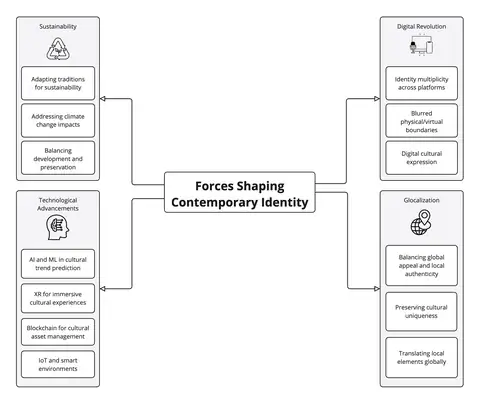
Once the two registers are separated, the pressures acting on both come next. The Four Forces → You will learn The digital revolution, glocalization, technological advancement, and sustainability, read as coequal and simultaneous.
Continue, inside Frameworks

The lenses were used on a real commission. Read the Dadar Edit.